Solving Healthcare Challenges Through Liferay DXP’s Capabilities

Introduction
The healthcare industry faces challenges such as data security, interoperability, and patient engagement. Liferay DXP offers a robust platform to address these issues and enhance healthcare operations for improved patient outcomes.
Key Challenges in Healthcare
The healthcare industry is facing a variety of challenges that impact the quality of care and operational efficiency. Understanding these challenges is crucial for organizations looking to improve patient outcomes and streamline their operations. Here are some of the key challenges in healthcare today:
1. Data Security and Privacy Compliance
Healthcare organizations face significant risks from data breaches, which can lead to financial losses and harm patient safety. Protecting sensitive patient data and ensuring compliance with regulations like HIPAA is critical. Robust security measures are necessary to prevent data breaches and safeguard patient privacy.
2. Collaboration Breakdowns
Ineffective communication between healthcare teams and providers can result in delays and treatment errors. Fragmented systems often hinder information sharing, impacting patient care. Ensuring seamless collaboration across departments is essential for improving care delivery and patient outcomes.
3. Interoperability Issues
Disparate systems, like EHRs and billing software, often fail to communicate effectively, leading to data duplication and delays in care. This lack of interoperability complicates care coordination and decision-making. Addressing this issue is crucial for creating a more integrated and efficient healthcare system.
4. Poor Patient Engagement
Patients expect personalized and accessible healthcare, but many providers struggle to meet these demands. This leads to lower satisfaction and retention rates. Implementing effective patient engagement tools is key to improving the overall patient experience and fostering better relationships with healthcare providers.
5. Scalability and Flexibility
As healthcare organizations grow, their technology must scale to meet new needs and demands. Legacy systems can limit this growth by being rigid and unable to adapt to changes. Scalable and flexible technology solutions are necessary for organizations to stay competitive and continue providing high-quality care.
6. Cost of Software Adoption
Adopting new healthcare technology can be expensive, especially for organizations with limited budgets. It is essential to find cost-effective solutions that offer comprehensive features. Balancing cost and functionality is key to ensuring successful software adoption without straining resources.
How Liferay DXP Addresses Healthcare Challenges
Liferay DXP offers a comprehensive solution to many of the challenges faced by healthcare organizations. Here’s how it can transform the healthcare landscape:
1. Enhanced Data Security and Compliance
Liferay DXP prioritizes data security with enterprise-grade features such as role-based access control (RBAC), data encryption, and audit trails. These tools help healthcare organizations protect sensitive patient information and comply with regulations, ensuring that data breaches are minimized.
2. Improved Collaboration
With Liferay, healthcare providers can create a unified platform that fosters collaboration among medical teams and enhances communication with patients. By integrating various communication tools and shared workspaces, Liferay ensures that all stakeholders have access to the information they need, when they need it.
3. Seamless Interoperability
Liferay’s API-driven architecture allows for seamless integration with existing systems, including EHRs and billing software. This interoperability enables healthcare organizations to create cohesive ecosystems where data flows effortlessly, reducing redundancy and improving patient care.
4. Personalized Patient Engagement
Liferay empowers healthcare organizations to build customized patient portals that centralize various services, such as appointment scheduling, telehealth consultations, and access to medical records. Through features like audience targeting and personalization, healthcare providers can deliver tailored content and services, significantly enhancing patient engagement and satisfaction.
5. Scalability and Flexibility
Liferay’s modular architecture allows healthcare organizations to adapt to changing demands easily. Whether integrating new technologies or expanding services, Liferay’s flexible deployment options (on-premise, cloud, or hybrid) ensure that the platform can grow alongside the organization.
6. Cost-Effective Solutions
As an open-source platform, Liferay DXP provides a cost-effective solution for healthcare organizations. The Community Edition offers robust core functionality without the hefty licensing fees, allowing organizations to build customized solutions tailored to their needs.
Transforming Healthcare : The Role of Liferay DXP
Healthcare organizations must urgently undergo digital transformation to address inefficiencies and meet the evolving needs of patients. Digital Experience Platforms(DXPs), such as Liferay DXP, are ideally positioned to support this transition by offering holistic solutions. When assessing Liferay DXP for healthcare, consider these essential factors
| Criteria | Description |
|---|---|
| Interoperability | Check that the platform can easily link with current EHRs, billing software, and other healthcare tools. |
| Scalability | Choose a solution that can adapt and grow with your organization, handling more users and data as needed. |
| Compliance and Security | Make sure the platform complies with healthcare standards like HIPAA and GDPR. |
| Customization and Flexibility | Look for a system that can be easily tailored to meet your specific workflows and patient needs. |
| Cost Efficiency | Assess both the upfront costs and the long-term maintenance expenses involved. |
| Patient Engagement Features | Evaluate whether the platform offers features like customized patient portals and communication tools to enhance engagement. |
Benefits and Capabilities of Liferay DXP for Healthcare
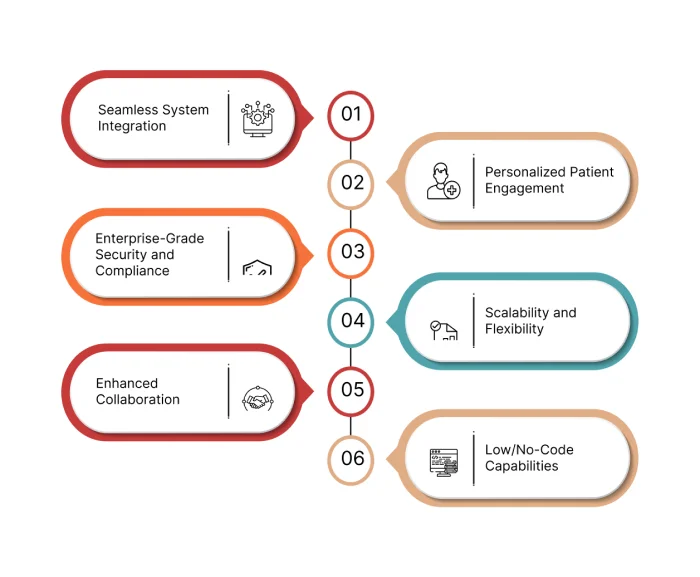
1. Seamless System Integration
Liferay DXP’s robust API-driven architecture, along with advanced tools like its module framework and integration frameworks, facilitates smooth connectivity between diverse systems:
- Unified digital ecosystems.
- Reduced data redundancy.
- Timely access to critical patient information.
2. Personalized Patient Engagement
Healthcare providers can utilize Liferay’s advanced capabilities to:
- Develop custom patient portals centralizing services such as appointment management and telehealth.
- Use Mobile SDK for accessibility across devices, catering to modern patient needs.
3. Enterprise-Grade Security and Compliance
Liferay offers enterprise-grade security and compliance with robust features such as:
- RBAC, encryption, and audit trails for data protection.
- Single Sign-On (SSO) and Identity Management for secure access.
4. Scalability and Flexibility
Liferay DXP supports the growing needs of organizations by:
- Allowing easy adaptation to new technologies and regulatory changes.
- Providing flexible deployment models and a range of enhancements through the Liferay Marketplace.
5. Enhanced Collaboration
Liferay fosters seamless collaboration across teams by:
- Shared workspaces and secure messaging.
- Real-time access to patient data, improving communication between teams.
6. Low/No-Code Capabilities
Non-technical users and developers can:
- Build and modify applications quickly.
- Speed up development cycles, reducing dependency on IT teams and lowering costs.
Conclusion
Liferay DXP is an excellent choice for healthcare organizations, offering seamless integration, strong security, and scalability to enhance patient engagement and streamline operations. It’s a powerful tool for driving digital transformation in healthcare.


